

Accounts
Cruise Accounting Software
Centralized management of financial accounting data
cruisePAL’s Accounting module is designed specifically for multinational, multicurrency, and multi-company cruise operations. It covers all aspects during the vessel management cycle. The cruise accounting software can integrate core modules such as Procurement, Crewing, and Payroll.

Centralized Financial Management

Comprehensive Integration

Automated Financial Workflows

Customizable Reporting
Centralized Financial Management
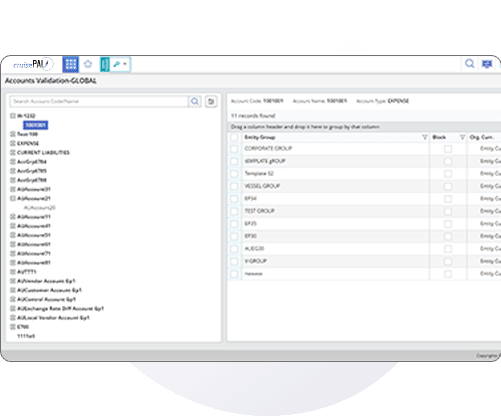
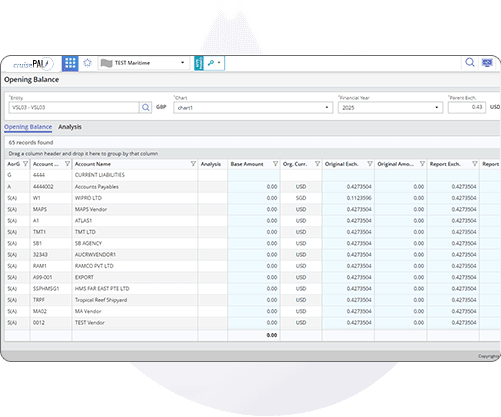
cruisePAL’s Accounts module consolidates financial accounting data, including multiple currencies and charts of accounts, onto a single, easy-to-navigate platform.
Comprehensive Integration
Integrates smoothly with other core modules like Procurement, Crewing, and Payroll, ensuring a connected system that covers all aspects of cruise management throughout the vessel lifecycle.
Automated Financial Workflows
Streamline processes such as invoice processing, bank transfers, and tracking financial transactions with advanced automation and EDI (Electronic Data Interchange), saving time and reducing human error.
Customizable Reporting
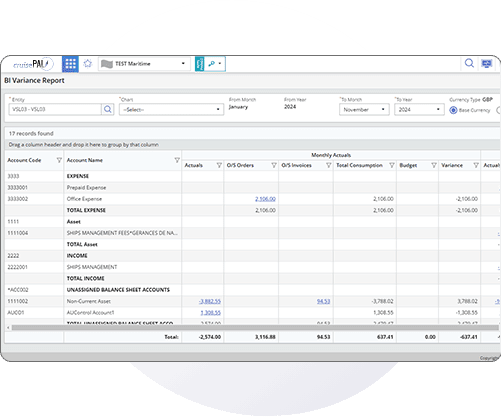
Benefit from tailored reports, including accounts receivable/payable aging, fiscal calendars, and KPI reports, all of which can be customized based on the specific needs of cruise owners or managers.
Product features
Frequently asked questions
What is maritime accounting software for cruise operations?
Maritime accounting software for cruise operations manages the full financial accounting cycle for cruise lines and vessel management companies — including multi-currency accounts, multi-entity consolidation, accounts payable and receivable, budget management, and regulatory reporting. cruisePAL’s Accounts module is built specifically for multinational cruise operations, integrating with Procurement, Crewing, Payroll, and other operational modules for centralised financial management.
How does cruisePAL's Accounts module handle multi-currency and multi-entity accounting?
cruisePAL’s Accounts module supports simultaneous management of multiple currencies, multiple company entities, and multiple charts of accounts within a single platform. Exchange rates, inter-company transactions, and consolidated financial reporting are managed automatically, enabling cruise lines and vessel management companies with global operations to maintain accurate financial records across different regulatory and tax environments.
Does cruisePAL's Accounts module integrate with procurement, crewing, and payroll?
Yes. cruisePAL’s Accounts module integrates with the Procurement, Crewing, Payroll, Fixed Assets, and Insurance modules within the cruisePAL platform. This integration ensures that purchase orders, crew wage transactions, insurance claims, and asset depreciation entries flow directly into financial accounting without manual re-entry, providing real-time financial visibility across the full vessel management cycle.
What is automated invoice processing in cruisePAL's maritime accounting module?
cruisePAL’s Accounts module uses EDI (Electronic Data Interchange) to automate invoice receipt, matching, approval routing, and payment processing. Invoices received electronically are matched against purchase orders, routed through configurable approval workflows, and posted to the general ledger automatically — reducing manual data entry, accelerating payment cycles, and minimising invoice processing errors.
How does cruisePAL's Accounts module manage vessel budget tracking and expense control?
cruisePAL’s Accounts module allows vessel budgets to be set by cost centre, department, or expense category, with actual expenditure tracked in real time against budget allocations. Managers receive alerts when spending approaches budget limits, and can run variance reports comparing actual versus planned costs at vessel, fleet, or company level — supporting proactive financial control rather than end-of-period reconciliation.
What customisable reporting does cruisePAL's Accounts module provide?
cruisePAL’s Accounts module provides customisable financial reports including accounts receivable and payable ageing, general ledger summaries, vessel P&L statements, budget variance reports, KPI dashboards, and fiscal calendar-based period reporting. Reports can be filtered by vessel, company entity, currency, cost centre, or date range, and exported in standard formats for external audit or board reporting.
What is centralised financial data management in cruisePAL's Accounts module?
cruisePAL’s Accounts module consolidates all financial accounting data — transactions, currency positions, accounts, and supporting documents — into a single platform accessible by authorised finance teams across ship and shore. This centralisation eliminates reliance on disconnected spreadsheets, ensures a single source of truth for financial data, and provides full audit trail access across the entire cruisePAL document suite.
How does EDI integration benefit cruise ship accounting in cruisePAL?
EDI (Electronic Data Interchange) integration in cruisePAL’s Accounts module enables automated exchange of financial data with suppliers, banks, and external systems — including direct bank transfers, supplier invoice receipt, and tax authority submissions. This automation reduces manual financial processing, accelerates payment cycles, and ensures accurate, timely financial operations for cruise lines managing complex multinational accounting obligations.
Who uses cruisePAL's Accounts module?
cruisePAL’s Accounts module is used by financial controllers, vessel accountants, and finance teams at cruise lines and ship management companies. It is designed for organisations that need to manage vessel accounting across multiple companies, currencies, and regulatory environments simultaneously — where a single, auditable financial platform is essential for accurate reporting and compliance.
How does cruisePAL's maritime accounting software compare to generic ERP financial modules?
Generic ERP financial modules require significant customisation to handle the specific requirements of maritime accounting — vessel-level cost coding, crew wage accounting, port disbursement management, multi-flag VAT handling, and insurance claim tracking. cruisePAL’s Accounts module includes these capabilities as standard, integrated with cruise-specific operational modules, reducing implementation complexity and ongoing customisation costs.
Does cruisePAL's Accounts module support full financial audit trails?
Yes. cruisePAL’s Accounts module maintains complete, tamper-evident audit trails for all financial transactions, journal entries, invoice approvals, and payment records. The audit trail is accessible across the full cruisePAL document suite, enabling finance teams, external auditors, and flag state authorities to trace any transaction back to its originating operational record.
Can cruisePAL's Accounts module manage port disbursement accounts and vendor payments?
Yes. cruisePAL’s Accounts module manages port disbursement accounts, vendor payment terms, and supplier ledgers as part of the broader procurement-to-payment cycle. Integration with the Procurement module ensures that approved purchase orders flow directly into accounts payable, with payment status visible in real time across both the finance and procurement teams.